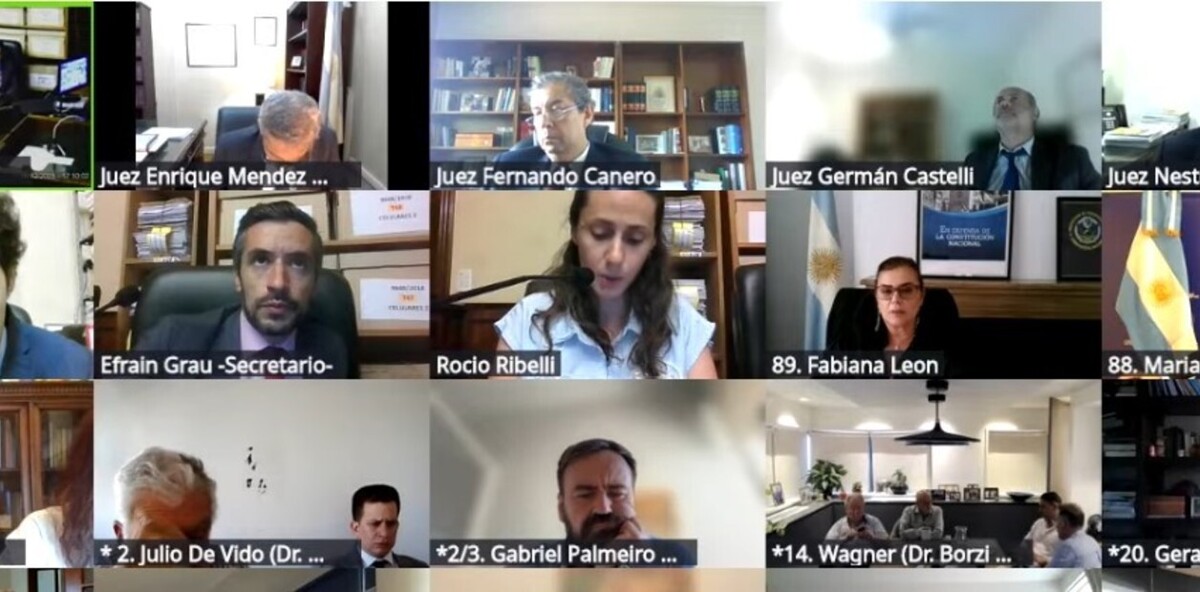
Buenos Aires, December 19, 2025 - Total News Agency - TNA - The oral trial for the "Notebooks" case, which investigates a corruption network during the governments of Néstor and Cristina Fernández de Kirchner, advanced this Thursday with the reading of the accusation by the Financial Information Unit (UIF) in the section known as the "Cartelization of public works" or the "Little Chamber." The accusation attributes to former President Cristina Elisabet Fernández de Kirchner the receipt of 175 bribes for more than 171 million pesos and 613,000 dollars in illegal payments associated with the awarding of road works, as presented by the prosecution before the Federal Oral Court No. 7. The UIF argued before the court that there was a "spurious agreement" between public officials and businessmen that allowed for the maintenance of a mechanism of illegal returns linked to contracts for public works and services awarded by the National Directorate of Vialidad and other state bodies. According to the accusation, while these illegal payments were being made, the same business group acted as one of the main tenants of the hotel conglomerate Los Sauces S.A., which is being investigated in parallel for money laundering. The trial for the "Notebooks" case, initiated last November and being held before the TOF No. 7, represents one of the most important judicial processes of the last decade in Argentina due to its political and economic reach, given the magnitude of public funds involved and the prominence of the accused, including high-ranking former officials and key players in the road construction sector. The presentation included a list of dates and amounts prepared by financier Clarenz, which documents the cash deliveries allegedly linked to the payment of bribes. The file described the administrative scheme that would have allowed the commission of these illicit acts. The former Minister of Federal Planning, Julio De Vido, would have had a central role in setting up the system, delegating its coordination to the former Secretary of Public Works, José López, and the practical execution to the former head of the Argentine Chamber of Construction, Carlos Wagner, while Clarenz would have acted as the collector of the illegal funds. The request to elevate the case to trial also included analysis of segments after the year 2010. According to the UIF, the scheme was based on resolutions signed by then-head of the National Directorate of Vialidad, Nelson Periotti, which enabled financial advances ranging between 10% and 20% of the amount of the public works, or, in their absence, set sums equivalent to work certificates when those advances were not concretized. Additional details were also highlighted about the business relationships between the Kirchners and some of the involved business groups. According to the accusation, that circuit would have operated in an "oiled and pyramidal" manner, raising funds in favor of the main accused, including Cristina Kirchner, Julio De Vido, José López, and financier Ernesto Clarenz, whom the prosecution qualified as co-authors of the crimes of passive bribery and organized corruption structures. During the reading, which lasted for several hours, the prosecution detailed that the 175 illegal payments would have been made between January 2008 and September 2010 and that subsequently, a large part of the money would have been delivered to the deceased Daniel Muñoz, former private secretary to President Néstor Kirchner. The former comptroller of the Kirchner family, Víctor Manzanares, as a collaborating accused, described that Néstor and Cristina Kirchner would have rented the hotel complex Los Sauces to the Relats Group for a high monthly fee, generating estimated income between 10 and 11 million dollars, which, according to him, functioned as a "main financial leverage" in the increase of the presidential family's patrimony. The list of those prosecuted and sent to trial also includes prominent businessmen such as Cristóbal López, Fabián de Sousa, and Osvaldo de Sousa, to whom five illegal payments for about 14 million pesos were attributed between 2011 and 2012 through the construction company CPC S.A., belonging to the Indalo Group. The continuation of the reading of the accusation and the development of the process are expected to provide new elements on the alleged illicit association that would have operated for years in the awarding and execution of public works in the country.